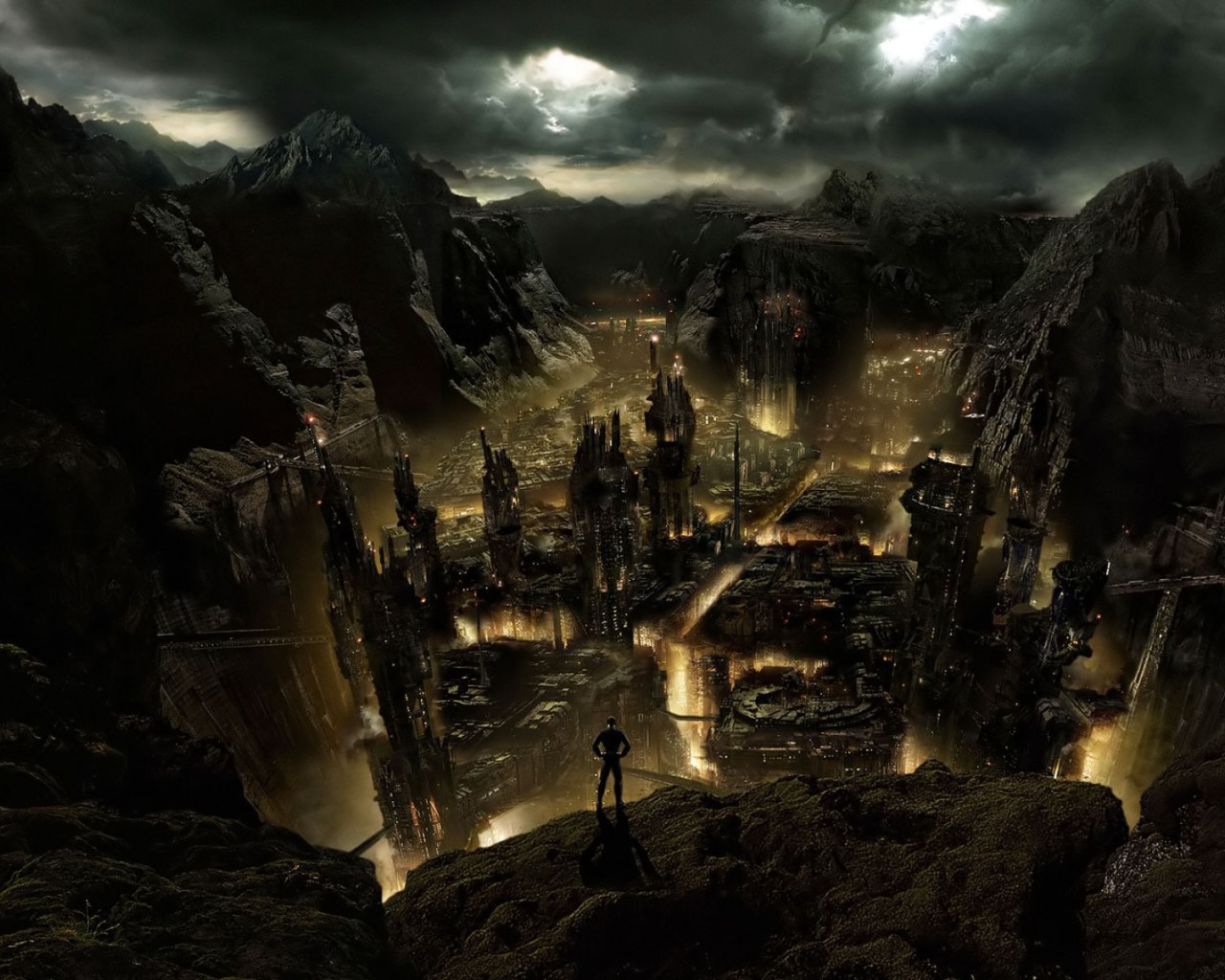
"Humanity is slowly shutting down" - Jesse Hasek, 10 Years

Sunday, October 21, 2012

30 Days of World-Building (Second Edition) - Day 10 - Mood and Culture

Exercise 10 - Settle on the overall mood for your story if you haven't already. Look through your timeline, political groups, and language notes and mark for revision anything that doesn't fit your mood. If you have time, revise those things. Otherwise, leave them for later.

The mood I have settled on will consist of dark, supernatural overtones with aspects of suspense, horror, steam punk  and adventure. Throughout the course of the story, the Doctor will have to overcome obstacles both in his medicinal practices and in physical confrontations, as encounters with the Blood Harvesters seldom end well. As a result, he has become highly proficient with the use of single-shot pistols, and carries one on his person at all times, along with his traveling doctoring bag.

The aspect of the supernatural will be portrayed through the blood medicine that the Blood Harvesters utilize. Fittingly enough, this concept will also address the horror aspect, in regards to the sheer fear and gore that comes from these experimental blood practices.


Steam-punk will be addressed in terms of the technology made available through the cities. Widespread electricity, mechanically-driven steam shops, clockwork robotics, and more can be witnessed in the cities.

30 Days of World-Building (Second Edition) - Day 9 - Language

Exercise 9Listen to how different syllables sound to you. Do they excite you? Do you associate a particular sound with an emotion or place or memory? Write down some generic preferences for your languages, and then go listen to what those things sound like. Write down the syllables you hear when you run a faucet or sit by a stream, for instance. Those sounds will be your "root" syllables when making up names for places and people and things.

The language that exists in this world is shared through most of the country. Those in the Cities are more educated, and therefore, use a more sophisticated form of communication. Those in the Fringe villages are not so fortunate to possess an education, and their speaking patterns and word choices are affected because of this. 

(To be honest, language is not the main focus of this story. I know my linguistics professor would yell at me for that, but I won't be worrying too much about language, lest another language come to light during this creation process.)

Saturday, October 20, 2012

30 Days of World-Building (Second Edition) - Day 8 - Econ & Politics

Exercise 8 - For five minutes, make a few notes on your map to mark places that have more of a type of resource, and jot down anywhere that has definite deficit of something needed. When you're done with the resources, take another ten minutes to identify which major groups in your civilizations care about which resources.

Resources in the Fringe Cities are slim - there is seldom enough firewood for every house at night, and deaths are commonplace during the winter months, especially along the River of Blood. Electricity is pretty much non-existent in the Fringe villages, and when it is present, it is seen as mystical and unnatural by some.

The reason resources in the Fringe cities are slim is because the Cities have taken most of it - as if they didn't already possess enough. Resources are abundant in most cities, and people wouldn't have to go far to buy oil for their heat lamps, or firewood for their cobblestone fireplaces.

The Blood Harvesters take what they can, whether through moral or immoral gains - to the Fringe villages, they have become little more than bandits, and some villages negotiate with them - resources and food in exchange for the ability to live another month.

30 Days of World-Building (Second Edition) - Day 7 - Recent History

Exercise 7 - Spend 15 or more minutes outlining the major historical events of the last 100 years before your novel begins.

Prior to the 18th century (Early and Mid 17th century) - The discovery of minerals and precious ores as conduits for technology, the cities developed massive excavation machines, and began to carve into the plains separating the Cities from the Fringe villages. While the operation was a success, it left four vicious scars across the plains, which stand as a reminder of the price of advanced technology. A reminder that is sorely ignored by the cities. At the same time, the ousting of the Blood Harvesters took place, as their killings grew increasingly violent. The Blood Harvesters scattered throughout Castravia, but some believe they still haunt the land. They are right to fear them . . . for the threat is truly alive, and very real indeed . . .

1700 - At the turn of the century, breakthroughs in technology were astounding: The discovery of controlled currents made widespread electricity possible through street lamps, which were soon commonplace in the cities, machines replaced animal and human labor, freeing up more time for philosophical thought and the arts. At this time, opportunities for would-be inventors were at their peak . . .

1713 through present - Thirteen years after this period of industrial revolution, the Fringe villages started suffering from plagues and diseases. At first, these occurrences were rare. But as time moved on, the plagues became more and more common. The symptoms became more violent as well, and since nobody knew how to combat these sicknesses, those that caught it could do little more than wait for death . . .

1715 - The emergence of the Blood Harvesters. Fringe villages suffer from these attacks, where villagers would go missing overnight, accompanied by vicious and terrifying screams. Calls for help to the Cities are rarely answered, and the Fringe villagers become excruciatingly cautious and self-sufficient because of this . . .

1715 - News of the plagues reach the Cities, accompanied with the appeals for help regarding the Blood Harvesters. Those invested in the profession of Doctor band together in order to aid the Fringe villages in dealing with the plague. They are seen as "gutless sympathizers" by some in the cities, who believe that if the Fringe villages have it so bad, they could come to the Cities, where all is perfect. A viewpoint that is sorely ignorant of the reality of the matter. Their efforts are wholly self-funded, which unfortunately, cuts into the cost of their equipment. Their efforts are equally seen as pointless by the higher-ups in the Cities . . .

1750 - The main protagonist is born, the bright and curious-eyed son of a doctor and his mistress, who served in the establishment where he worked. He is raised within the walls of his father's workplace, and is introduced to the doctor profession at an early age . . .

1775 - Over the next generation, technology in the Cities grows tremendously, while the Fringe villages slowly begin to fade away. The efforts of the Doctors Union have saved some villages, but the vast majority of the Fringe villages went unaided, not due to lack of compassion, but lack of equipment and time . . .

1776 - Our story begins, as our protagonist has been hired as a traveling doctor for a merchant caravan striking out into the Fringe villages . . .

Friday, October 19, 2012

30 Days of World-Building (Second Edition) - Day 6 - Races

Exercise 6 - Spend 10 minutes figuring out what people who evolved in each major area of you world would look like. Then spend another 5 minutes asking "what if this group encountered that group?" Would they fight? Trade? Both? Inter-marry and blend their genetic types? Would they remain largely separate, with pure strains of both racial groups co-existing (not necessarily peacefully)? How would that encounter be brought about in the first place?

First note worth mentioning: this story features primarily human beings, with references to the supernatural here and there. While drastic differences in basic features don't occur, differences arise based upon social background and physical living location.

Second note worth mentioning: while regions exist within this world, most people are separated by whether they lived on the Fringe or in the Cities. Villages and cities can differ slightly, based on location and ruling forces, but overall, the similarities outweigh the differences.

The Fringe-Dwellers - The tough, down-to-earth, hard-working for meager pay citizens of your typical village. Most are hardened to the rough environment at an early age, and as a result, genetics have resulted in Fringe-Dwellers having naturally broad shouldered and calloused on both the palms and feet. While some villages suffer heavily from plagues or sickness (especially those along the River of Blood), others are self-supporting: they may still have to pay recompense to the queen, but most of the time, those on the Fringe are left to their own means. Calls for help are rarely answered, and when they are, the armed forces are meager, rambunctious, and, rather ironically, more of a problem instead of a deterrent . . .

The City-Dwellers - The often-frail, philosophical, and servant-employing citizens of your typical city. Those with the good fortune of being born in the cities are nurtured towards a life of luxury: the cost of living anywhere within the city would be considered a small fortune to those on the Fringe. In addition to this "silver-spoon" attitude, the City-Dwellers are heavily invested in science and philosophy: they are always looking for the key to absolute knowledge, they want to know how their world works. Is there a higher power? If so, what does he or she want? Additionally, most City-Dwellers think of those on the Fringe as a plague, and try their hardest to fortify their cities against those who bear signs of sickness. While this level of paranoia is rather commonplace, most of those employed in the profession of Doctor reject these claims. These doctors (who have formed their own union within own particular city) are instead pursuing a different mission: eradicate the disease plaguing the Fringe-Dwellers. This has drawn ire from the high society, but no direct action has taken place yet . . .

The Blood Harvesters - Most people believe they don't exist. Others fear them more than death itself. To be captured by them is to face a fate that even the most demented of torturers couldn't bear to imagine. These people were driven to the edge long ago, when fear of the plague and sickness was at it's peak. Originally a radical group of City-Dwellers, they believed that their blood was poisoned by this plague. As a result, they were possessed by this idea that if they could exchange blood with someone else, they could be rid of their sickness. They haunted the cities, as City-Dwellers would vanish in the middle of the night. People wondered why the Queen didn't order them exiled. Appeals to those in charge went unnoticed. Eventually, the City-Dwellers took a stand, and launched a counter attack against the Blood Harvesters. However, they managed to escape, fleeing to every corner of the continent, some far beyond the reaches of the Queen's power. They still haunt the City-Dwellers today, and the stories and legends have seeped into the tales of the Fringe-Dwellers, transforming a once real and dangerous threat into a ghost story meant to scare children into obedience. They have been silent lately, but people have begun to go missing from the Fringes . . .

Relations - Communication between the Cities and the Fringes is minimal: the occasional trade caravan passes through, but fear of the plague often scares most traders away from the caravans. Those that do venture in the Fringes often invest in hiring a doctor to serve them while they travel, in case one of them gets sick on the road. The Blood Harvesters have become little more than myth now, but certain individuals in high society know that they are, in fact, very real. Some even have . . . business deals with them, every now and then . . .

30 Days of World-Building (Second Edition) - Day 5 - The Map

Exercise 5 - Draw out the physical contours of your map, and then identify at least three places that your people may live. You don't need names for them yet - we'll worry about names next week. Just draw a dot on the map or maybe sketch a little "house" symbol to indicate that people have settled that area.

Over the course of the day, I'll take time to sketch out a rough outline of a map. Once I finish it, I'll take a photo of it, and upload it here, to give you a rough idea of the map. Until then, you'll have to take it on faith that I've finished this exercise. Thanks for understanding!

Thursday, October 18, 2012

30 Days of World-Building (Second Edition) - Day 4 - Cataclysms

Exercise 4For 15 minutes, jot down some of the Really Big Land Features you want in your story and think "what if that were made by..." Write down a couple of causes for those features and scars. Which scars are slow-force scars (plate tectonics), and which are fast-forces (anything that takes less than 10,000 years is medium-to-fast in geological scales).

The Northern Mountains - Existed as long as people have lived in the region, dark and imposing, myths and rumors speak of blood harvesters who prey upon unsuspecting travelers, cries of help to those in power often go unheard; most of them have stock in the blood trade anyway . . . 


Plains-Scar - Efforts were undertaken here to obtain precious metals and materials from deep underground. Previous attempts would have been rendered obsolete, but new technology allowed for faster excavation techniques. While the excavation proved successful (and gave rise to many of the technologies seen in the cities), it left a vicious scar across the plans, miles wide and thousands of feet across four extremely deep crevasses. Ways exist to climb down into the scars, but few venture down there, for rumors of dark creatures and blood harvesters who prey on the weak scare off most would-be intruders . . . 

River of Blood - It doesn't take long to learn of the fatalistic nature of this particular river. The entirety of the river is tinted with a coppery-red color. This is due to the mixture of sediments that form and coagulate farther up the river. In addition to it's off-putting appearance, the sediments combine to form a fatal poison - anybody who ingests the water or ingests a creature who had previously drunk from the river while slowly die. The poison works through their stomach, causing internal stomach pains, violent vomiting fits, and eventually, death, as the poison eats away their insides . . . 

The Blighted Forest - Nobody knows why these forests exist. By all accounts, the trees and plants should have decayed long ago. But yet, they persist. Blackened, lifeless trees jut out from every crevasse, accompanied by plants and thorn vines. Some trees even grow through solid stone, it seems, like weeds. The soil here is impenetrable by normal tools, and attempts to excavate here haven't even been thought of: there seems to be absolutely nothing to gain from these lifeless forests. However, something unseen seems to be keeping these forests standing. What could it be? Perhaps something underground? . . . 

30 Days of World-Building (Second Edition) - Day 3 - Mood and Setting

Exercise 3 - Read over your list from Day 1, then turn to a blank piece of paper. Close your eyes and think about what kind of feeling you like to have when you write or read. Write down four words that fit into that feeling: two adjectives, a verb, and a noun. Now return to your climate and emotions list. If any of the words match, you have your climate. If not, try to find the closest-matched words.

List - 

mysterious, intriguing (adjectives)
exploring (verb)
key (noun)

Climate - 

Temperate Forest/Plains (interspersed with villages and cities)

Wednesday, October 17, 2012

30 Days of World-Building (Second Edition) - Day 2 - Physical Planet

Exercise 2 - What role will weather play in your story? Any ideas at this stage are not set it stone. Instead, come up with (ten)* plot devices that relate to weather, and what they would do to the story.

Thunderstorm - interrupt and short circuit electrical conduits, making for a dark and horrifying chase scene or for a dramatic tension moment when electricity is crucial

Heavy Fog - impair vision, causing tension during critical dramatic or combat sequences

Snowstorm - complicate overland travel, detour character's plans, perhaps trap them inside somewhere they would rather not be

Cold Snap - cause sickness and death in communities unprepared, freeze retained water supplies, interfere with electrical devices, causing a temporary, but horrifying, darkness, both figuratively and literally.

Flash Flood - temporarily halt river transportation, carry plague and disease throughout the regions affected, complicate overland travel

*WRITER'S NOTE* Realistically speaking, the setting I've chosen will only work with a specific range of natural phenomenon. The chance of dust storms, tropical storms, or hurricanes is near 0%

30 Days of World-Building (Second Edition) - Day 1 - Climate and Variety

Around February and March earlier this year, I conducted a similar project for another work of fantasy. That project has (for now) been filed away, and will be revisited at a later date. Who knows when? Only time will tell. But I digress.

With NaNoWriMo a short two weeks away, I figured I would use this opportunity to prepare myself for the rigorous writing schedule that such an event calls for. The world I will be creating over the next 15 days (two posts a day - against what the project calls for, but I'm running on free time in between college classes) will be used for my up and coming NaNo story.

All I can say right now is this: It will be a supernatural/horror story with elements of Victorian/Gothic style, including the style of dress, architecture, social and judicial construction, and so forth. Perhaps with a twist of steam-punk tossed into the fray. I've always wanted to write something with a steam-punk edge. Perhaps now will be the kick-in-the-pants I need to start writing the damn thing.

Anyway, without further adieu, here is the first post in my Second Edition of 30 Days of World-Building.

Exercise 1 - Find an international map or atlas, and observe the different climates and how they appear and behave. Then, for fifteen minutes, list all the climates you can think of. After that, write one or two words describing either the climate itself, or how each of the climates makes you feel.

Temperate Forest - mysterious, inspiring
Plains - grandeur, happiness
Arctic - bitterness, insecurity
Tundra - cold, barren
Mountainous - majestic, insurmountable
Jungle - wet, dark
Desert - hot, barren
Beachfront - comfortable, carefree

Wednesday, August 22, 2012

College: A Virulent and Vibrant Beast

After tomorrow, I will have lived at the IPFW Student Apartments for one week. They say that you can't draw conclusions about anything after a short time, but that couldn't be farther from the truth. From the quiet roommates who never utter a sound to the obnoxiously loud individuals whose taste in music could be extensively questioned. But I digress.

As for the classes themselves, they are proving to be (not going to put my foot in my mouth and say they are a piece of cake) as difficult as I thought they would be - which is, honestly, not too hard. They expect you to read, do your work, and think outside of class. If you do that, you'll pass the class. On the same notion, I'm coming to approve of the structure of college classes, and the amount of freedom that you are allotted. IPFW is a campus full of many different people of many different ages, and as such, the professors and staff treat you similarly. It isn't like high school where the teachers pretend you don't know about things. In college, they nip that particular social problem in the bud. 

But of course, there are options for the not-so college worthy crowd. Nights of boozing and mindless chit-chat among fellow students who won't remember your face tomorrow, let alone your name. And as per usual, opportunities will arise to join with this crowd. Temptation will be fierce and abundant. I strive to not join that crowd. 

Also, I would like to say thank you to the wonderful messages of encouragement from all those who read my father's post from a week or two ago. The messages were very heart-felt, and I appreciated reading every single one of them. 

Well, that's that. Hope that I'll break in this college thing soon, and find those who wish to talk to me. And those that like to play pen-and-paper RPG's. My inner nerd has been yearning to play lately. 

Sunday, June 17, 2012

Father's Day: Breaking the Shell

Too often, I have heard you treat yourself to a variety of notions that you are "not a good parent". 

I strive to think otherwise. Every time your children say, "No, you are awesome!", we mean it. We wouldn't lie about something like that. That would get us nowhere.

So let me simply indulge you by saying that you are the best father we could possibly have. By writing this, I hope to break that shell that you have spent years building around yourself. Our mistakes are not pinned on you. They are pinned on us, and us alone.

Thank you for being there for us, no matter how often we roll our eyes, oblivious to the reality of things. 

Thank you for raising us to treat others as we would want to be treated, no matter how often we seem to forget.

Thank you for gracing us with the privileges we have, no matter how often it seems we don't deserve them.

Thank you for introducing us to great music and cinema, without which we would trapped in the so-called allure of rap, dub-step, and sub-par horror flicks.

Thank you for the occasional morning smell of pancakes and bacon. I don't care if the mix comes from a box, they are the best pancakes on the whole damn planet (brownie points for guessing the reference, by the way).

And I personally thank you for opening me to the world of Dungeons and Dragons. Without that creative outlet, I wouldn't have developed this present love for fantasy. 

And last, but certainly not least, I credit you with being my inspiration for becoming a writer. I had always loved to write since I was young, but who did that come from? You. I saw your writing, and said, "I want to become that." In all honesty, I haven't reached your level yet. But then again, writing is a pastime all to one's own. No writer can reach the level of another. So, I guess I should say that I hope to emulate the talent that you hold in the field of writing.

Too often, you put yourself down. A trait that I too have developed. But I am trying to break the shell of despair that I build. And I think you should too.

From your eldest son, with love that should be shown more often

Thursday, April 19, 2012

Music and Writing

"The Philosopher in Meditation" by Rembrandt
It is no secret that music holds a special place in my life. After all, I have a playlist linked right on this page (should be over on the left somewhere). But not only does music sound aurally pleasing, but it also opens my mind to situations and scenes that I could be writing.

In my music, I prefer those songs that convey hidden messages weaved carefully within the lyrics. These kind of lyrics make me think (A forbidden concept!) about all the idiosyncrasies of our world. It makes me think about the ideas that few even approach.

In my stories, I similarly like to include messages that speak for my personal philosophy. Through my writing, I hope to convey the emotions and thoughts that are buried deep within my psyche. You may think me strange . . . but in the end, isn't that all we are? Strange beings moving and colliding with one another without even knowing - or even acknowledging - the bigger questions?

Friday, March 9, 2012

30 Days of World-Building - Day 30 - Last Day

Exercise 30 - Today's exercise is to NOT exercise. Give yourself a break from world-building to let the ideas sift themselves out in your mind before you start writing like a fiend tomorrow.

Today's post will be simple. No worries about anything, just like the prompt said. Instead, I'm just going to relax and enjoy the company of my girlfriend tonight. Then after I take her home, and the clock strikes midnight, I will begin to write like the proverbial fiend that the above exercise believes I am.

Thursday, March 8, 2012

30 Days of World-Building - Day 29 - Character II

Exercise 29 - Look in your social and cultural world for not just the places where your character doesn't fit in, but also the places where he or she does, and note them in your character notes. Make sure that, by the end of today, you can name your character's parents and siblings, the town where they grew up, their age and any training they've had, and the three most influential people in their lives.

Places Hadrian DOESN'T fit in:

  • The northern tundra cities, due to his upbringing in a temperate zone. On a physical scale, Hadrian would not be able to survive as well as people naturally born there. Also, despite his actions to dodge his lessons, Hadrian truly loves his grandparents, and wishes the best for them. Once in a blue moon, he'll even offer to help them. And as noted yesterday, the elders of the north wouldn't be too accepting.
  • The marshland and jungles in the southwest, again because of his physical upbringing. Also, while he may be self-sufficient, the flora and fauna of the jungles differ greatly from those of the woods, and he wouldn't know the difference between poisonous or safe, hostile or docile
Places Hadrian DOES fit in:
  • While he was raised in a small trade-village, Hadrian finds early on that he is easily accustomed to the winding streets of the cities. Among the people, he is able to satiate his curiousness without having to subject himself to the elements of the forests. It is, in a sense, his own concrete jungle.
  • There is nowhere that Hadrian feels more at home than in the shrouded forests of Kasova. Particularly in the forests surrounding Coppervale, he has explored everywhere he can imagine. He has drawn countless maps that nobody but him can read, written in scrawls about the wonderful things he has found, and spent his days dreaming of the world beyond the confines of his grandparent's home.   
Other facts:
  • Hadrian's parents, ____________________________ , raised him in the small village of Kern. However, they sent him to Coppervale to live with his grandparents when he was five years old, following a vicious blight that swept across the crops for miles around. It has been eight years since he has seen them.
  • Apart from parents, Hadrian holds very few people as high as he does the heroes of the realm. He admires their bravery, and wishes that he possessed the courage that they had. However, as the story progresses, Tomas Gerridon III, Professor Drevan, Headmaster Grecian, and the other strong characters he meets will shape his destiny in ways that he couldn't imagine. In addition to teaching him magic and aiding him in his endeavors, they also teach him morals and values that his parents and grandparents never got the chance to teach him themselves.  

Wednesday, March 7, 2012

30 Days of World-Building - Day 28 - Left Out

Exercise 28 - Spend 15 minutes thinking about two or three of any left over topics that haven't been covered in any of the previous exercises.

Clothing - Most common people who work for their living do so in semi-comfortable breeches and tunics, with belts, hats, cloaks, and other accessories as necessary. Seldom do they attempt to woo anybody with their clothing. In higher societies such as Valthiem, Aloren, and Brel, the upper class take to adorning their already high-style clothing with numerous gemstones, both practical and impractical. If overdone, this can make them seem prideful, no matter how important they truly are. However, apart from a few exceptions, the typical formula is: More gemstones = More influence and power.

Disease Treatment & Medicine - Touched on briefly during the recent history post, the main source of medicine and healing comes from the Church of Elohim, the goddess of healing and good fortune. Most cities and villages, especially those west of the Chador mountains, have access to a shrine/church of Elohim. Clerics and medicine men work out of these establishments, and use both mixtures of potions and salves as well as magic to heal injuries. As part of their code, they only use their magic when people are severely injured, and would not be able to live properly otherwise.

Clerics and the Shadow-Taint - A modern phenomenon among the realm of Cordaire, these few men and women are sorcerers who have somehow severed their ties to the Shadow Realm. For those afflicted with the taint, this often results in death, as the taint infects an entire body, and in a sick twist of fate, is the only thing keeping the afflicted alive. However, for the few that survive, the process is truly life changing. If the once-afflicted person worshiped a particular deity, that deity would accordingly appear to them in a vision, and instead of carrying them over, blesses them and names them an emissary of their faith. Additionally, the person is blessed with certain abilities given to them by the deity. Thus, the clerics of Elohim being able to heal injuries with a simple touch.

Treatment of Elderly - In most societies, the elderly are held in high respects. Their family and friends are deemed socially responsible for their well-being, and must tend to them, or be regarded as heartless and cruel. For the most part, the elderly appreciate this treatment, and do their best to return the favor. But in the cold northern mountains, the elderly are not so accepting of the aid. For them, growing up in the harsh world was a part of life, and in a society where personal merit and pride are readily prevalent, bowing out and letting the younger generation take over is considered weak. In fact, it is considered to be an insult to ask an elderly person if they need help.

Tuesday, March 6, 2012

30 Days of World-Building - Day 27 - Plot Hooks III

Exercise 27 - You may or may not have an outline of your actual whole-novel plot yet. If you do, read through your list of plot hooks and your outline, and match the hooks to wherever they might fit into the story. Next month, when you get to that part of your story, you’ll decide if you need to throw the plot hook or device into the story, or if it’s superfluous.

Basic Outline is as follows:
  • Prior to the start of the story, Hadrian discovers a small sapphire buried in the earth under a tree
  • Tomas takes Hadrian as his apprentice, after realizing the true potential the boy possesses.
  • While journeying back to Brel, the two encounter the dark creatures mentioned earlier (Hadrian's first experience with the gemstones).
  • Narrowly avoiding capture, the two hastily make towards Brel.
  • They are hunted all the way back to the city, and they catch wind of a bigger plot festering in the dark woods of the north (Hadrian learns of his innate magical abilities).
  • While Tomas is seeking aid from the University, Hadrian meets his future love interest. Interestingly enough, she too bears the taint, but uses its power for very different reasons than most would suspect.
  • Tomas returns, bearing a summons from the headmaster himself. Aware of Hadrian's talent, Tomas sought for him to be able to hone it, by taking proper magic lessons in the University.
  • Hadrian's first lessons in magic, and witnessing the true power of the taint. He also gets to witness the process through which the gemstones are made.
  • More to come . . . (Watch this post for edits)

Monday, March 5, 2012

30 Days of World-Building - Day 26 - Anti-What If

Exercise 26 - Look at your "mood words" list and then at your notes and outlines and ideas. Put anything that doesn’t match at least one mood word (or a synonym of a mood word) onto a separate page or in a separate file. You may end up putting your misfits into this novel when you're stuck or need some inspiration or when there's an opportunity for them to fit in. You may even, when you get tired of the main storyline, decide that you want a subplot of Misfits, something to give a little comic relief, perhaps, or just an alternative tone to your main story-line.

Not to brag, but after looking through all my outlines, lists and notes, I wasn't able to find anything that didn't readily fit into any of my mood categories. Now, this isn't necessarily a good thing. Any good story needs a break from the intensity of the main story-line.

Therefore, I may add in the start of a romantic character arc. When Tomas and Hadrian finally reach the city of Brel, Tomas has to acquire some information from the college. Hadrian is denied entry, despite Tomas' attempts to let him in. As Hadrian is waiting outside, he runs into his future love interest. At first, the attraction is simply physical. However, as they begin to talk more, they both become aware of their innate connection (Could she also be afflicted with the taint? The odds of that? Duh. High. This is a fantasy story, after all).

Sunday, March 4, 2012

30 Days of World-Building - Day 25 - Sky

Exercise 25 - Read this article and then figure out: how many moons does your world have? How long is a month for each of them? What are they named? Do you have any scenes already plotted in which moonlight is absolutely necessary? If so, be sure to write down the phase of the moon you need on that date, and use that date as your "touchstone" for what phase the moon will be in on other days. If you need to, write out the moon's calendar and as scenes happen when you write them in November, jot them into your calendar so you know what kind of moon your folks might encounter at those times.

To be honest, I fell victim to what that article described. Typically, I never really regard the sky in my stories, and I've never thought of how the stars, suns, and moons can affect the daily lives of the characters.

Therefore, in my story, there will be a singular moon (name pending), with phases that correspond to the day within a set month. More research on moon phases will be coming soon . . .

Also, might experiment with a little tribal worship centered around the moons (inspiration from the Khajiit of Elder Scrolls lore?).

Saturday, March 3, 2012

30 Days of World-Building - Day 24 - Mood III

Exercise 24 - Go through your notes and make a "m?" note next to anything that doesn't actively fit into the mood you want to convey. It's all right to have mismatched moods, of course; in many ways, it's crucial to have a variety. But you want to know, when you write your novel, if a particular element is going to dilute the mood or not.

For the most part, my mood remains constant through the entirety of the plot. At some moments, there are areas that allow for humor, and others that allow for a love interest to grow. But for the most part, the suspense-filled area of the plot dominates the novel. This may cause the novel itself to seem dark, but I hope that will not be the case. There will be moments where the protagonist, for a little while, forgets all about the dark and dangerous future ahead of him. Those will be the moments he lives for. The reader may enjoy the suspenseful events that he finds himself in, but they will also relish in the opportunity to lay back and enjoy the good aspects of life.